If you’ve ever opened MetaTrader 5 and started on indicators like there’s a prize for the busiest chart then you’re not alone. Most traders—especially those getting into prop firm challenges have done it. Bollinger Bands here, RSI there, MACD lurking in the corner, and maybe a moving average crossover just to be safe. It feels productive. It feels professional. But is it really helping you or just turning your charts into a mess?
In prop trading, where precision and clarity are everything, less really is more. So let’s talk about indicator overload on MT5 and how to build clean and effective layouts.
Why Indicator Overload Happens
Due to uncertainty, most traders overload their charts. The natural tendency is to depend on additional clues when you are unsure about your approach. What the MACD failed to corroborate, perhaps the RSI will. You could finally obtain that certain indication if the Fibonacci levels and the stochastic lines line up.
Traders with chart decoration skills are seldom sought after by prop businesses. They are looking for traders that can confidently execute, understand market structure, and read price movement. In addition to slowing you down and making decision-making more difficult, overloaded charts are also visually taxing.
The Minimalist Mindset:
When you’re trading with a prop firm account, every decision matters. You’ve got daily drawdown limits, strict risk rules, and evaluation phases that demand consistent performance. There’s no space for second-guessing because RSI and Stochastic don’t agree with each other.
That’s why clean types of charts in MT5 matter. When you strip away the noise, you’re forced to actually read what price is telling you. And that’s a superpower in prop trading.
Step 1: Start with a Clean Slate
Open MT5 and hit that Reset Chart button or start a new chart entirely. Clear out everything. No moving averages, no oscillators, not even the grid if it’s distracting you.
You’re not deleting your edge. You’re creating space for it to breathe.
Step 2: Pick ONE Primary Indicator
Most successful prop traders don’t rely on stacks of indicators. They’ve tested their strategy and they trust it. So here’s the challenge—pick one primary indicator that fits the style you trade.
Some solid picks for prop traders:
- Moving Averages (EMA or SMA): Great for trend following or identifying dynamic support/resistance.
- RSI: Simple way to gauge momentum or find divergences.
- MACD: Useful if you’re looking for crossovers or trend momentum shifts.
- ATR (Average True Range): More of a volatility measure than a signal, but fantastic for prop trading risk control.
Just pick one that complements your approach. For example, if you’re a breakout trader then maybe you don’t need RSI. But an ATR might help you size your stops.
Step 3: Use Price Action as Your Foundation
This one’s a game changer. Price action should be front and center—always. Not as a sidekick to your indicators but as the main character in your trading story.
On your clean chart, start marking key areas:
- Support and Resistance
- Previous Highs and Lows
- Trendlines
- Order Blocks or Supply/Demand Zones (if you use them)
These are the areas that institutions and prop firms especially—pay attention to. You don’t need five indicators to tell you when price reacts at a major support level. Your eyes and brain are your best tools.
Try watching how price behaves at these key levels before you ever check an indicator. It’s incredible how much more confident your decisions become.
Step 4: Keep It Color-Coded, Not Color-Crazy
One common trap with MT5 layouts is turning the chart into a rainbow. You’ve got green RSI, red MACD, orange moving averages, and purple trendlines.
Stick to one or two main colors for your drawings and indicators. Maybe blue for trendlines and support zones, and red for resistance. Keep your indicators in muted tones so they don’t overpower the candles.
Speaking of candles—keep them simple. Classic green and red or black and white. Avoid anything that distracts you from the price itself.
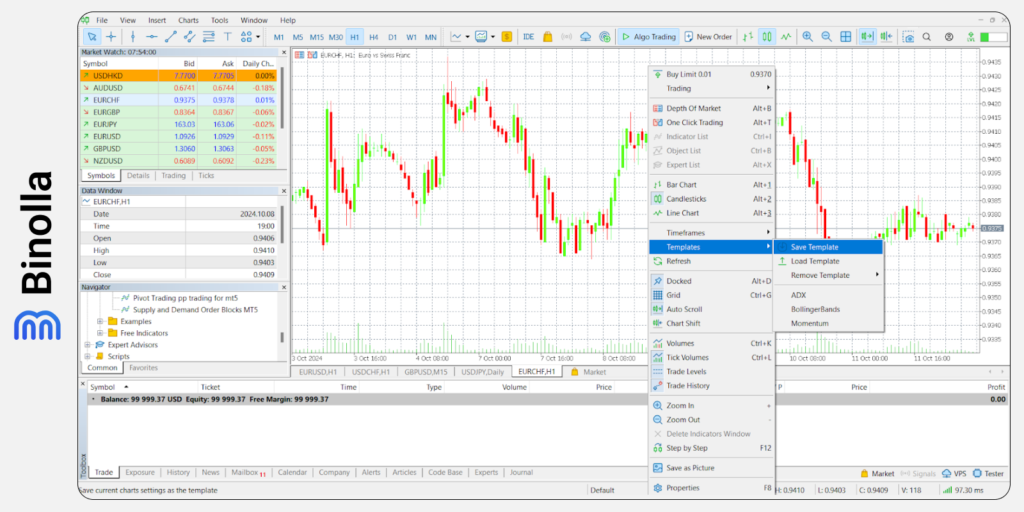
Step 5: Save Layout Templates for Different Strategies
If you trade more than one style then intraday scalping and swing trading—it’s okay to have different chart setups. But don’t try to blend both into one Frankenstein chart.
MT5 lets you save custom templates. Use this!
Set up a clean chart with the indicators and levels relevant to that strategy, and save it as a template. For example:
- Scalp Clean Template – Might have a 9 EMA and 21 EMA, volume, and no other indicators.
- Swing Template – Maybe just a 50 SMA and price zones.
- Risk Template – For managing open trades with ATR and risk-to-reward levels.
Switching templates takes a second, and it saves you from redoing charts or getting tempted to keep everything visible all the time.